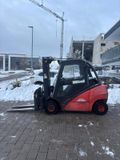
Linde's H series covers counterbalance trucks with combustion engines, in other words diesel and LPG forklifts, with capacities from 1.4 to 18 tonnes. On the second-hand market the models between 1.4 and 8 tonnes are in particular demand, because they cover almost every task from the warehouse to the building-materials yard. This article explains the model designations, compares the 391, 392/393, 1202 and 396 series, describes the hydrostatic drive and shows what to look for when buying a used Linde forklift. The figures are based on manufacturer datasheets and market examples; individual machines may differ.
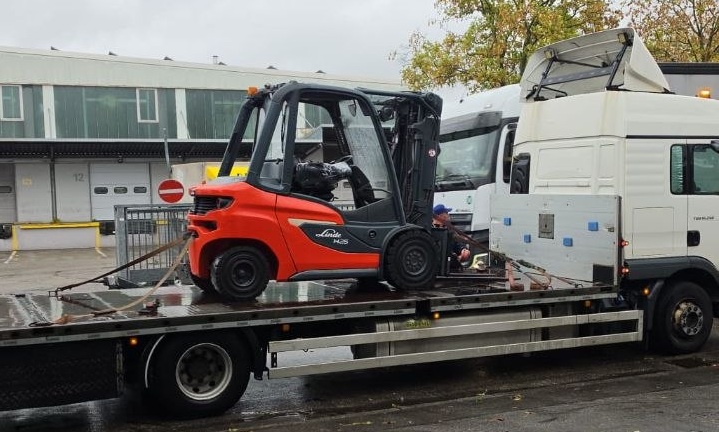
How to read a Linde forklift designation
The designation follows a fixed scheme. The H stands for the combustion-engine series, the number for the rated capacity in hundreds of kilograms: the H14 carries 1.4 tonnes, the H25 2.5 tonnes, the H80 8 tonnes. The drive follows: «T» for LPG and «D» for diesel, for example H25T or H30D.
Additions reveal further features. A «/600» as in the H25/600 means a load centre of 600 instead of 500 millimetres, «-01» or «-02» marks the version and «EVO» a revised generation. The series number, such as 391, 393 or 1202, is shown on the data plate. On diesel trucks «3A» or «3B» indicates the emission stage under EU Directive 2004/26/EC: 3B means a version with a diesel particulate filter, 3A without a filter.
Comparing the series
| Models | Series | Capacity | Drive | Feature |
|---|---|---|---|---|
| H14, H16, H18 | 391 | 1,4 / 1,6 / 1,8 t | Diesel, LPG | Compact and versatile for warehouse and yard |
| H20 – H35 (EVO) | 392 / 393 | 2,0 – 3,5 t | Diesel, LPG, natural gas | Decoupled cab, diesel with or without particulate filter (3B/3A) |
| H20 – H35 | 1202 | 2,0 – 3,5 t | Diesel, LPG | Hydrostat, dual-pedal control, Load Control, wireless data transfer |
| H50 – H80 | 396-03 | 5 – 8 t | Diesel, LPG | Two maintenance-free variable pumps, torsion support, heavy loads |
The hydrostatic drive of the H series
A hallmark of the H series is the hydrostatic travel drive. According to Linde it works without a gearbox, clutch, differential or drum brakes, which should lower service costs and raise availability. On newer models the operator controls the truck with two pedals. In addition, the mast and the drive axle are decoupled from the chassis and the cab to reduce vibration and shocks. When buying second-hand this means wear on the clutch and gearbox is not an issue, while the drive pump, hydraulic hoses, oil condition and radiator are important checkpoints.
H14, H16 and H18 (series 391)
The small models carry 1,400, 1,600 and 1,800 kg and are particularly common on the second-hand market. Typical machines have lift heights of roughly 3.1 to 3.8 metres and a lowered mast height of around 2.1 to 2.5 metres. Depending on equipment, Simplex, Duplex or Triplex masts are fitted. The service weight is around 2.8 to 3.1 tonnes. Full cabs, heaters, work lights, side shifts or a third hydraulic circuit for attachments such as bale clamps are common. As the diesel version, the H14D is very compact at about 2.2 metres in length and 1.09 metres in width.
On the market there are machines from 2017 to 2021 with roughly 3,000 to 16,000 operating hours. On the LPG model, check the gas system with regulator, lines and connections for leaks.
H20 to H35 (series 392, 393 and 1202)
This class covers 2.0 to 3.5 tonnes and is probably the most sought after in the used trade. According to the datasheet the 393 series also includes natural-gas versions besides diesel and LPG. The newer 1202 series relies on a hydrostatic drive, dual-pedal control, Linde Load Control, slim mast profiles for good visibility and wireless data transfer for fleet management.
As an example, one market listing describes an H25T of the 392 series (built 2018) with a lift height of 3,250 mm, a mast height of 2,227 mm, 150 mm free lift, 1,200 mm forks, super-elastic tyres, a third valve and a half cab at about 3,800 operating hours. The H30D of the 393 series weighs roughly 4.4 to 5.2 tonnes depending on mast and equipment, with lift heights of about 3.2 to 6 metres. The operating hours in market examples range from about 3,800 to almost 20,000, although year of manufacture and condition matter more than the number alone.
H50 to H80 (series 396-03): heavy loads
For loads of 5 to 8 tonnes Linde offers the H50, H60, H70 and H80, with the H80 also available with a larger load centre of 900 or 1,100 millimetres. According to the datasheet this series uses two maintenance-free variable pumps for travelling and lifting, the cab, chassis and engine are decoupled threefold, and the Linde torsion support reduces swinging of the load. The EU diesel version has a stage 4 particulate filter. These trucks are used for heavy-duty work on outdoor areas.
Diesel or LPG: which suits you?
- Mostly outdoor use, heavy loads, rough ground: diesel (D).
- Alternating between warehouse and yard: LPG (T), observing ventilation and risk assessment.
- Emission-free indoor areas: no combustion engine, an electric truck is the better choice.
- Very heavy loads from 5 tonnes: H50 to H80 as diesel or LPG versions.
- Variable load centres: look for models with «/600» or a larger load centre.
Checklist for buying second-hand
- Note the data plate: series, load centre and drive determine the datasheet and spare parts.
- Operating hours and service records: they show how the truck was used and maintained.
- Engine: check cold start, exhaust, running noise and the cooling system. On diesel trucks note the emission stage (3A/3B) and any particulate filter.
- Hydrostat and hydraulics: check the drive pump, hoses and cylinders for leaks and smooth operation.
- LPG system: check the regulator, lines, connections and the mounting of the cylinder.
- Mast and forks: check chains, rollers, free lift and fork wear, plus the third valve if attachments are used.
- Tyres and cab: check the condition of super-elastic or pneumatic tyres, doors, heater and lighting.
- Documents: request the latest safety inspection record and the operating instructions.
Frequently asked questions about used Linde forklifts
What does «/600» mean on Linde trucks?
It indicates a load centre of 600 instead of 500 millimetres. The stated capacity applies to this larger load distance.
What is the difference between H25T and H25D?
Both have a capacity of 2.5 tonnes. The «T» stands for LPG drive, the «D» for diesel drive.
How many operating hours are normal?
That depends on year of manufacture and use. Market examples range from a few thousand to almost 20,000 hours. The service history and the condition of the engine, hydraulics and mast matter most.
What is a hydrostatic drive?
The travel drive uses hydraulic pumps and motors without a gearbox, clutch or differential. This allows smooth acceleration and precise manoeuvring.
What do 3A and 3B mean on diesel trucks?
They denote the emission stage under EU Directive 2004/26/EC. 3B is the version with a diesel particulate filter, 3A the version without.
Looking for a used Linde forklift?
Browse our current range of checked Linde trucks or get advice on choosing the right model.
View Linde trucks